Products You May Like
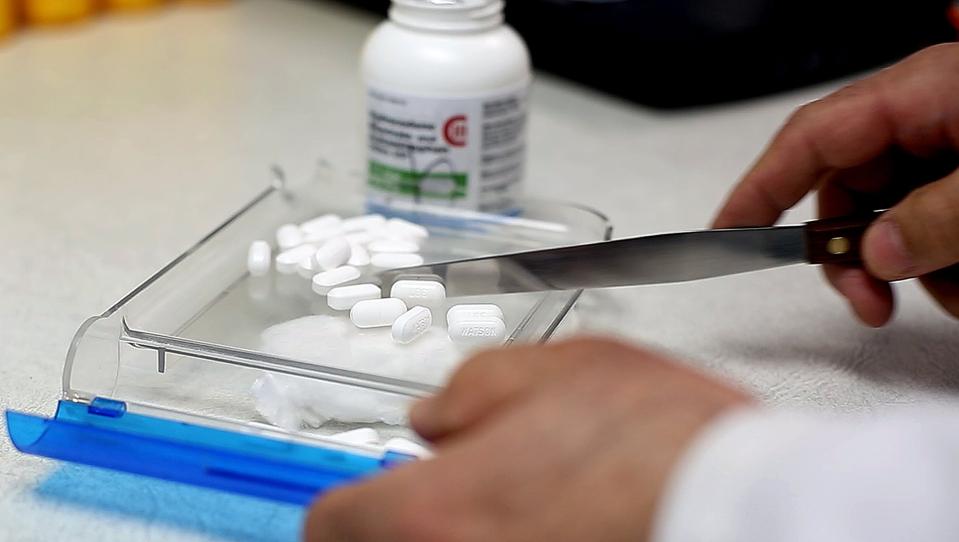
A pharmacist counts pain medication at a South Portland pharmacy. (Photo by Gabe Souza/Portland Press Herald via Getty Images)
Getty Images
For states, opioids may become the new tobacco. That is to say, states increasingly believe lawsuits against drugmakers and others involved in the sale, marketing, and manufacture of the pain-killers are a potential source of significant revenue. Indeed, close observers of state and local finance see the litigation as a near-copy of the suits against tobacco companies in the 1990s that eventually led to a $200 billion-plus global settlement.
At a recent Tax Policy Center panel on the state finances, I asked John Hicks, Executive Director of the National Association of State Budget Officers, if that is what states are thinking. His simple answer, “Yes.”
Complex suits
At least 46 states have sued one firm, Purdue-Pharma. Just this week four—California, the District of Columbia, Hawaii and Maine—filed individual suits against the company. In March, the firm settled an Oklahoma suit for $270 million. In May, another defendant, Teva Pharmaceuticals, settled for $85 million with Oklahoma.
At least 1,600 cities, counties, and Native American tribes filed their own suits against drug companies, pharmacy benefit managers, and others even including pharmacies. In 2018, those suits were consolidated into a single case that is being heard in federal court in Cleveland. A trial is due to begin in October. It is considered one of the largest, most complex cases ever filed.
The size and scope of this litigation has observers predicting the eventual outcome will be a global settlement that mimics the resolution of the massive tobacco dispute in the late 1990s.
What will happen with the money?
But that raises another question: What will happen to the money? State attorneys general argue that funds recovered in litigation would be used to cover the costs of treating victims of opioid addiction and related initiatives. And surely some of it will.
But the tobacco settlement experience suggests that states may very well divert a large share of the funds to other, unrelated uses.
A 2005 study published in the journal Health Affairs found that six sample states shifted settlement money to many other programs. Michigan allocated much of its settlement pool to a merit scholarship program and, after 2000, used no settlement funds for anti-smoking initiatives. North Carolina initially allocated more than half of its windfall to tobacco growers and communities hurt by the global settlement. Eventually, some of the money was used to fund health-related programs—and some of that likely helped those with smoking-related disease. But other settlement revenues were used to reduce the state’s budget deficit.
A 2007 Government Accountability Office (GAO) report calculated that states used only about 3.5 percent of settlement funds for tobacco control. Thirty percent was used for general health programs and 22 percent to close budget gaps. A 2014 National Institutes of Health study concluded that settlement funds were associated with declines in spending for smoking control efforts.
The problem with taxes
Of course, it is too soon to know what states would do with funds they receive from their opioid lawsuits. But if they follow the past pattern and use settlement funds for other purposes, what can they do to mitigate the overuse of the painkillers?
Some would tax opioids. New York State adopted such a levy this year and a dozen other states are considering the idea. Their goal: Punish producers and sellers and make them pay for the social cost of opioid abuse.
But such a levy raises two problems. First, some users will turn to easily available untaxed—but potentially more deadly— illegal sources of the drugs.
Second, how would a tax distinguish between those who are abusing the drugs and those who legitimately need heavy-duty painkillers after surgery or to manage intractable pain from chronic diseases such as cancer? A tax-driven price increase might be intended to reduce opioid abuse, but it would impose unwarranted costs on those who legitimately need the drugs.
Taxing a sometimes-good
In contrast, the case of taxing smoking is easy. While little good comes from tobacco use, there is a good from pain relief, and sometimes opioids are the best way to get it. Taxing a sometimes-good is complicated. Better solutions: Cover drug treatment with insurance and expand Medicaid. And don’t wait for the litigation to get resolved, spend the money now.
If states are serious about reducing the improper use of opioids, taxes are probably not the right tool. A big-bucks settlement with the drug industry will generate much-needed funds for physician and patient education, enforcement, and treatment—if states use those dollars that way. But based on history, I am not counting on it.